$7 trillion.
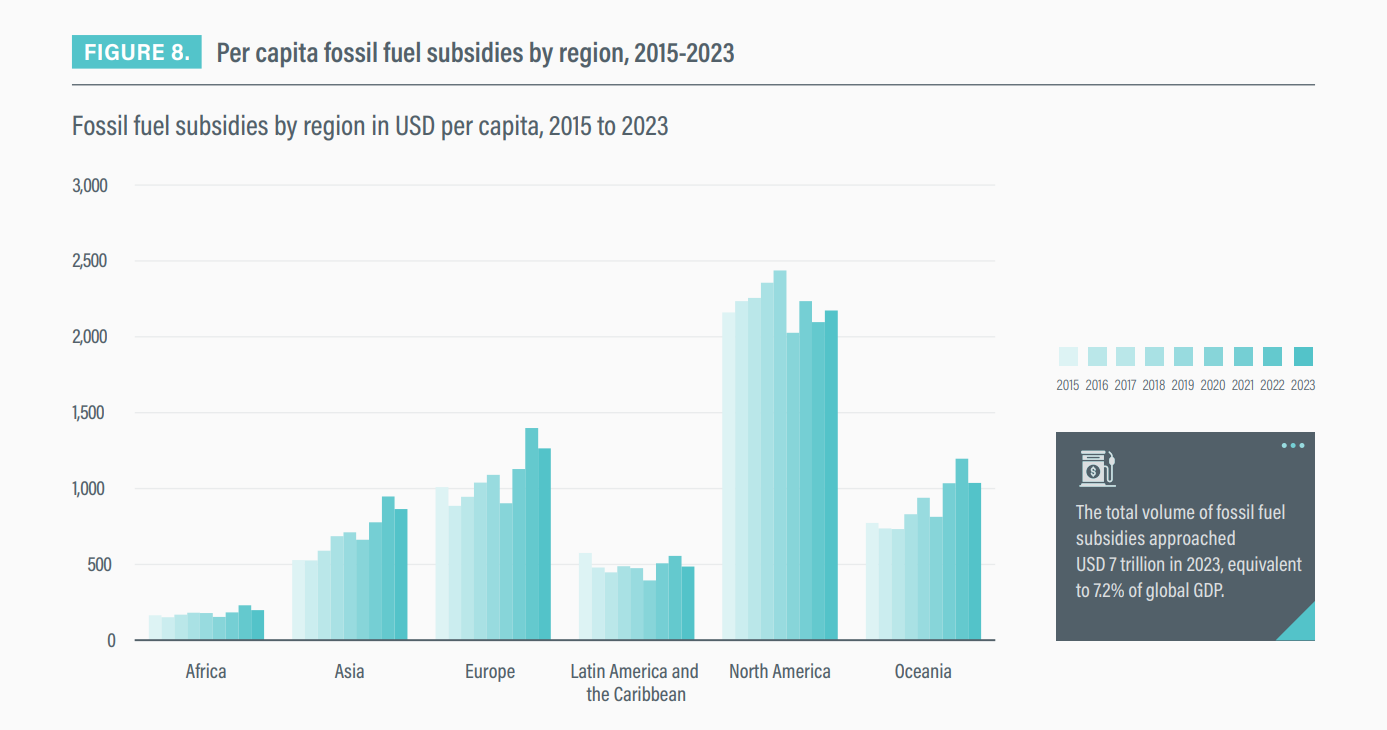
That is what was spent on fossil fuel subsidies globally in 2023. Not before the Paris Agreement. Not before the energy transition began. In 2023, the same year governments concluded the most significant climate stocktake in history, the same year electric vehicle sales broke records worldwide. Seven trillion dollars, actively spent keeping fossil fuels cheap. And transport sits at the heart of it.
The Transport, Climate and Sustainability Global Status Report – 4th Edition (GSR4) documents four paradoxes that explain why this number matters for the transport sector specifically, and why it makes every climate commitment made since Paris harder to deliver.
We spend nearly three times more sustaining the problem than it would cost to solve it
$7 trillion in fossil fuel subsidies in 2023, including both direct government expenditure and externalities. The transport transition costs an estimated $2.7 trillion per year until 2050. The standard argument against acting on climate in transport is cost. The transition is too expensive. There is not enough money. These two numbers, placed side by side, dismantle that argument. In a single year, governments spent enough on fossil fuel subsidies to fund nearly three years of the entire transport transition. The constraint is not financial. It is political.
Fossil fuel subsidies are not a legacy of inaction, they are an active, annual decision. According to GSR4 Chapter 1.1, 10 Years After the Paris Agreement and the 2030 Agenda, on the Path to the UN Decade of Sustainable Transport, these subsidies directly support conventional, car-centred transport paradigms. Every year they are renewed is a year the alternative could be funded three times over.. The same chapter documents that the transport sector received just $545 billion in climate finance in 2023, the vast majority directed to high-income countries. Only 3% reached least developed countries. Adaptation finance for transport averaged just $1.5 billion annually, barely 2% of global adaptation funding and a miniscule % of what is spent propping-up fossil fuels.
The money exists. It is being spent on the wrong things. Redirecting even a fraction of the $7 trillion toward clean transport would dwarf every climate finance commitment made to date. That is not a radical proposition, it is simple arithmetic.
Electric vehicle sales are breaking records. Transport’s energy mix has barely moved in a decade
EVs (Electric Vehicles) reached 21.7% of global passenger car sales in 2024. Fossil fuels still supply 90% of transport energy. In 2024, more than 58 million electric cars were on the world’s roads. EV sales grew 25%, accounting for 21.7% of all passenger car sales. By any measure, this is a significant market shift. And yet, according to GSR4 Chapter 5.1, Transport Energy Sources, fossil oil still supplied 95.4% of transport’s total energy demand in 2023. Renewable energy sources, biofuels and renewable electricity combined, accounted for just 4.6% of total energy consumption in transport, a share virtually unchanged since 2015.
oreover, by keeping conventional fuel artificially cheap, fossil fuel subsidies slow the economic case for switching to a more efficient EV, whilst ever-growing vehicle demand and size places increasing demands on energy supply. Sales of internal combustion engine vehicles rose to around 61 million units in 2024. SUVs, which consume around 20% more energy per kilometre than medium-sized cars, reached a record 48% of global car sales in 2023. Transport energy demand rose 4% in 2023, doubling the average annual growth rate of the previous decade.
Governments are subsidising the problem and !not the solution, and so the problem is winning.
No EV policy, however ambitious, can fully compensate for a pricing system that makes fossil fuels cheaper than they should be. Subsidy reform is not complementary to transport electrification. It is a precondition for it.
At COP28 in 2023, nearly every country agreed to phase out fossil fuel subsidies. Almost none have written it into their climate plans.
The phase out of fossil fuel subsidies was made in writing at COP28, during the first Global Stocktake, by nearly every government part of the UN. Governments agreed, for the first time, to transition away from all fossil fuels and phase out inefficient fossil fuel subsidies. GSR4 Chapter 2.1, National Transport Pathways to Reach Climate and Sustainability Goals, describes this as the most significant commitment ever made under the UNFCCC process.
What the GSR4 aims to understand is, are governments following through on this commitment? But what the analysis shows is the stark distance between that commitment and what governments actually write into their national climate plans.
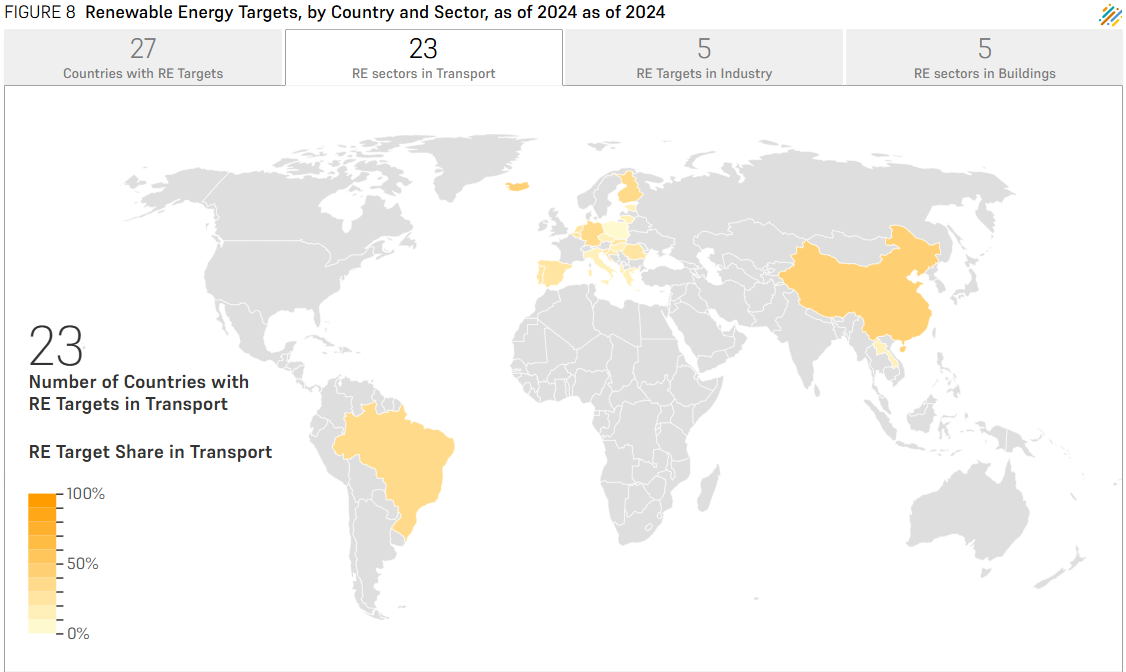
Only 4 out of 110 third-generation NDCs submitted by 15 January 2026 explicitly mention the phase out of inefficient fossil fuel subsidies across all sectors. These four NDCs are from Australia, Malaysia, Rwanda and the United Kingdom. The other 106 NDCs are silent on the issue. For updated data refer to the GIZ-SLOCAT NDC tracker. Additionally, as of 2024, 23 countries had renewable energy targets for the transport sector in place. Third-generation NDCs that do not address fossil fuel subsidies in transport are not just incomplete, they are inconsistent with what their own governments agreed to a few months earlier
The Climate Process is also not following through; COP30 in Belém was a moment to re-state and follow through on the COP28 commitments; COP30 marked a departure from the strong signals agreed by countries at the first Global Stocktake while the term fossil fuel was missing from any official outputs of Belém.
The carbon budget runs out in 2032. Subsidy reform is still being treated as a long-term ambition
Transport emissions need to fall at least 59% by 2050 to stay within 1.5°C. Under current policies they are projected to grow 30% by 2050.
According to the IPCC, as cited in GSR4 Chapter 1.1, 10 Years After the Paris Agreement and the 2030 Agenda, on the Path to the UN Decade of Sustainable Transport, Shaping the Just Transition: Challenges and Opportunities towards Sustainable Transport, achieving a 1.5°C pathway requires at least a 59% reduction in transport-related CO₂ emissions by 2050 compared to 2020 levels. Emissions need to decline at least 22% by 2035. Under current policies, they are projected to grow 19% by 2035. In 2024, transport CO₂ emissions hit new record highs, as the newest EDGAR data shows.
GSR4 Chapter 2.1, National Transport Pathways to Reach Climate and Sustainability Goals, adds a harder constraint: the carbon budget, the total amount of CO₂ the world can still emit to stay within 1.5°C would be exhausted by 2032 even if current NDC commitments are implemented as planned, with two-thirds of planned emission reductions scheduled for the period 2030 to 2050. The political timeline and the planetary physical limits and timeline are not aligned. Fossil fuel subsidy reform is being treated as something to phase in gradually. The carbon budget does not accommodate a gradual increase in ambition, that is not an option, we are running out of time..
Every dollar of fossil fuel subsidy keeps conventional fuel cheaper than it should be, stimulates demand for that fuel, discourages modal shift, and slows the competitiveness of public transport, walking, cycling and renewable energy in transport. The subsidies are not neutral background noise, they are an active force pulling the trajectory in the wrong direction at the moment it most needs to change. Phasing them out is not one option among many. Given the timeline, it is the most powerful lever governments have not yet pulled.
None of this is simple to do. Fossil fuel subsidies are not a monolithic policy and take many forms. They include direct government transfers, state-owned enterprises selling fuel below cost, and tax expenditures that vary significantly by country and income level. In many low- and middle-income countries, fuel subsidies are genuinely the primary mechanism protecting low-income households from energy poverty. Removing them without replacement risks real hardship for the people least responsible for the emissions they generate. At the same time, governments that subsidise fuel consumption are often also taxing it, fuel excise revenues fund roads, public budgets, and social programmes. Subsidy reform and tax reform are parts of the same conversation, and neither can happen without addressing what replaces the revenue and who absorbs the transition cost. The public backlash that has followed poorly managed subsidy removals, from Indonesia, Nigeria to France or Ecuador, is not irrational. It is the predictable result of reform designed without the people it affects. While an overnight removal of every fossil fuel subsidy is unlikely to happen or might not be desirable, countries should plan it, just, and sequenced reform that redirects public money from subsidising fossil fuel consumption toward the affordable, accessible sustainable transport alternatives that make the transition viable for everyone, including the people currently dependent on cheap fuel for subsistence and economic opportunities.
If governments have the data, the commitments, and, as the numbers show, the money, the question is no longer whether fossil fuel subsidy reform is possible. It is whether the political will exists to do it before the window closes.
The GSR4 makes the case in numbers. The $7 trillion, the 4 NDC out of 110, the carbon budget exhausted by 2032, these are not abstract statistics. They are a precise account of how much time and money has already been spent moving in the wrong direction. Although fossil fuel was not included in COP30 outcomes, the opportunity to phase out fossil fuel subsidies was manifested through two tracks: COP30 Presidency initiated a Roadmap to Transition away from fossil fuels in just orderly and equitable manner. In the same venue, coalition of governments, subnationals and other stakeholders committed to provide a political platform, complimentary to UNFCCC, to phase out fossil fuels through implementation driven action by organising Santa Marta Conference. This conference will be hosted by Colombia and the Netherlands. The Fossil FuelRoadmap, along with the UN Decade of Sustainable Transport (2026-2036) are the next moments to realign misaligned fossil fuel subsidies to investments in clean transport solutions.and there is already a traction for it, At COP30, Government of Chile, through Ministry of Transport and Telecommunications launched a declaration signed by 11 countries to reduce transport sector’s energy demand by 25% by 2035, with one-third of that energy coming from renewable sources and sustainable biofuels with an intent to phase out fossil fuels. What happens in those rooms, in those discussions, will determine whether the $7 trillion figure next year is higher or lower than this one.
The time to phase out fossil fuels subsidies was 50 years ago, the next best time is now. With Roadmap on Fossil Fuels, Santa Marta Conference, UN Decade of Sustainable Transport, Chile Declaration, there is momentum, it is up to the governments and stakeholders to capitalise on it.
All data drawn exclusively from the SLOCAT Transport, Climate and Sustainability Global Status Report, 4th edition (GSR4, 2025).