95.4%
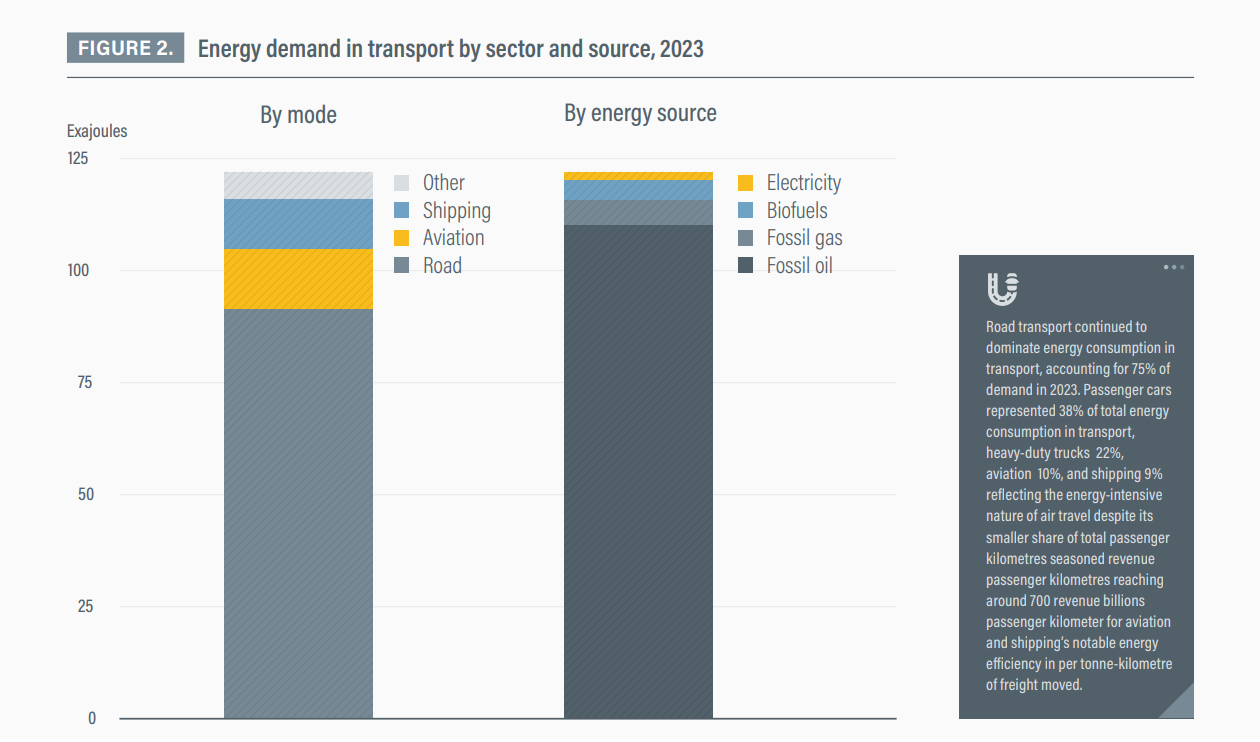
That is the share of transport energy that still came from fossil fuels in 2023. The same share as fifty years ago. Virtually the same share as when the Paris Agreement was signed in 2015. The same share through every oil shock, every climate summit, every record-breaking year of EV sales.
As this piece is written, the United States and Israel are at war with Iran. The global oil market is experiencing the one of the largest supply disruption in history. The reflex response, across very different political contexts, has been to reassure the public that fuel will stay affordable, not by cutting demand, but by guaranteeing supply, reducing taxes on fuels, increasing fossil subsidies, and finding other ways to keep prices manageable.
The Transport, Climate and Sustainability Global Status Report – 4th Edition (GSR4) documents these paradoxes that explain why the number has not moved. This GSR try to explain why the war in the Middle East is not a deviation from the fossil transport story. It is what fossil dependence looks like in practice: every transport system in the world is tied to a fossil-based supply it cannot control.
Electrification is growing on top of a growing combustion fleet
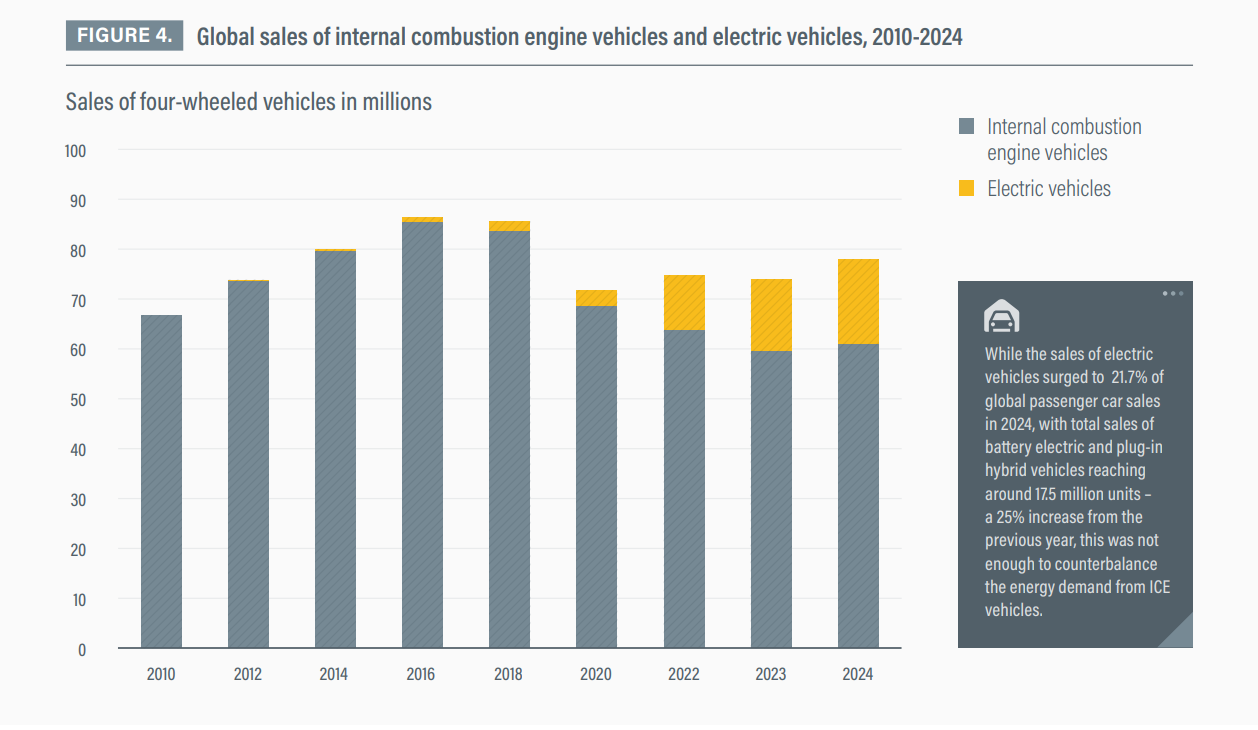
EVs hit 21.7% of global car sales in 2024. According to GSR4 Chapter 5.1, Transport Energy Sources, more than 58 million electric cars were on the world’s roads in 2024. Electric car sales surged across South-East Asia and Latin America. Since July 2024, China has been selling more cars with electric drivetrains than cars with internal combustion engines, a major milestone in the world’s largest automotive market. Globally, sales went up 25%.
However, this is still a drop in the ocean compared to the estimated 1.5 billion conventional diesel and petrol-powered cars on our roads. In 2024, 61 million vehicles running on fossil fuels were sold. Nearly every second car sold in 2023 was a sports utility vehicle (SUVs), a large vehicle that consumes on average 20% more energy per kilometre than a medium-sized car. The global car’s fleet is not being replaced, it is being added to. And the added vehicles are bigger, reinforcing the addiction to fossil fuels.
Electric vehicles do not reduce overall fossil fuel use unless they replace conventional vehicles faster than the demand . Right now, they do not. They grow on top. Transport energy demand grew 4% in 2023, double the previous decade’s average. The 95.4% holds because the total energy consumption pie keeps expanding and the renewable supply slice grows slower than the total demand pie. Electrification without a ceiling on combustion demand is decoration thus we need to accelerate a clean electrification out of fossi fuel.
Global supply chains are the provider for our fossil fuel addiction
Economic activity has been spurred by globalisation and interlinked supply chains around the world, maximising “comparative advantages” of locations and transporting people and goods. Yet the issue is that global supply chains are mostly catering to our fossil fuel dependence. As GSR4 Chapter 1.3, Transporting Shared Prosperity: Connecting Economies and People for a Sustainable Planet, shows, the most traded products by value globally were crude petroleum, cars and refined petroleum. In 2024, one-third of the global shipping fleet carried fossil fuels as cargo.
As the blockade of the Strait of Hormuz, or the 2021 accident in the Suez Canal show, global supply chains are extremely vulnerable to disruptions. A direct impact is that rerouting or idling of a container ship results in an additional consumption of an estimated 150 tonnes of fuel and costs around USD 75,000, according to GSR4 Chapter 1.4.Building Adaptation and Resilience Within Transport Systems and Across Communities and Economies, many regions and countries depend on fossil fuel imports, and with transport being the most fossil fuel-dependent sector, this creates major vulnerabilities.
Transport decarbonisation will result in major changes to our supply chains, freight movement and logistics. The GSR4 Spotlight ‘Logistics for Climate Action’ shows the transport sector’s critical role is in becoming resilient and low-carbon while enabling other sectors to achieve their transition as well. Global supply chains and logistics can offer essential levers for the transition of global and local economies towards a climate-friendly and resilient future.
Aviation is doubling a rounding error
Sustainable aviation fuel (SAF) production more than doubled in 2024. But it covered 0.3% of global jet fuel.
Every airline press release leads with the doubling. According to GSR4 Chapter 5.1, Transport Energy Sources, SAF production reached 1 million tonnes in 2024 and is projected to double again in 2025. From 0.15% of aviation fuel in 2023, to 0.3% in 2024, to a projected 0.7% in 2025. Meeting 2050 SAF targets requires an estimated USD 1.5 trillion over 30 years. Aviation CO₂ emissions were expected to surpass 2019 levels in 2025. Load factors hit 83.5% in 2024, the highest on record. Absolute emissions still rise because demand growth outpaces every efficiency gain.
Aviation’s decarbonisation story rests on a ‘fuel’ that, even growing at record pace, is covering under 1% of demand. The sector is banking on a future fuel supply that does not exist at scale, while burning more kerosene every year. SAF will be part of the answer, but the timeline does not work without the other lever: managing demand. That means pricing aviation fuel closer to its real cost, without subsidies, ending tax exemptions on jet fuel and on international travels, and shifting short-haul journeys to rail where the infrastructure exists or can be built. The countries already moving on this, through frequent flyer levies, short-haul flight bans on routes with rail alternatives, and kerosene tax reform, are the ones giving SAF a chance to matter.
Shipping has the framework, not the politics
62 green shipping corridors announced by late 2024. Six ready to implement. The IMO Net-Zero Framework, the first legally binding carbon price proposed for global maritime transport, adjourned in October 2025 by a US-Saudi-led alliance. In October 2025, the adoption meeting was adjourned for a year following opposition led by major oil-exporting economies.
If shipping were a country, it would have been the 9th largest GHG emitter in 2023, nearly equal to all transport emissions from Africa, Latin America and the Caribbean combined. Half of new ship tonnage orders in 2024 are capable of using alternative fuels. 62 green corridor initiatives have been announced, 40% more than in 2023.
The pattern is consistent. Voluntary measures in shipping are advancing: green corridors, alternative fuel ship orders, port commitments. The binding mechanism is the one that stalled. The IMO Net-Zero Framework would have applied a carbon price across every ship in international waters, the first instrument of its kind in any transport mode. The technology, the ships, the fuels and the routes are in place. The policy instrument that would make low-emission shipping commercially competitive across the whole sector is not. The proportion of the 95.4% in shipping does not hold because the alternatives are missing. It holds because the rules that would scale them are not yet in force.
NDCs clean the engine instead of changing the fuel
The GIZ and SLOCAT analysis of Nationally Determined Contributions (NDCs) shows few countries are committed to swiftly reduce fuel dependency. 110 third-generation NDCs submitted by 15 January 2026, out of nearly 200 countries party to the Paris Agreement. Inside those 110, transport actions skew heavily toward ‘Improve’ measures (cleaner vehicles, more efficient engines) at 65%. ‘Shift’ measures (moving people and goods with lower-emission modes like rail, public transport, walking and cycling) account for 27%. ‘Avoid’ measures (reducing the need to travel through urban planning and demand management) account for 8%. The policy mix is loaded toward the lever (improve measures?) that is least effective at the scale and timeline the limiting carbon budget exhaustion requires.
At COP28, governments agreed for the first time to transition away from all fossil fuels, triple renewable energy, and double energy efficiency. GSR4 Chapter 2.1, National Transport Pathways to Reach Climate and Sustainability Goals, describes this as the most significant commitment on transport ever made under the UNFCCC process.
The dominant transport decarbonisation measures countries are relying on, are vehicle electrification and improving efficiency. For significant demand reduction, along with Electrification and Improved efficiency, modal shifts is critical. Only 62 third-generation NDCs included actions on alternative fuels in transport. Only 35 of 110 NDCs submitted by January 2026 include actions on aviation and/or shipping emissions. At COP30 in Belém, the term ‘fossil fuel’ was absent from the official outcome text. The clearest signal in the other direction came from outside the negotiated text: at COP30, eleven countries, led by Chile, launched a declaration committing to resilient, low-emission transport systems, the kind of focused political signal the formal process did not produce.
The policy architecture mirrors the fuel mix. Governments commit to transitioning away from fossil fuels, then write climate plans that focus on making combustion engines cleaner rather than replacing combustion. The 95.4% is not an accident of slow progress. It is an output of a complex interwoven policy-geopolitics-market forces system designed to meet transport demand which concentrate of ‘Improve’ measures rather than reducing fossil fuel demand base. ‘Improve’ measures without Avoid and Shift keeps the fossil fuel mix intact. Santa Marta conference and the dedications of few countries to phase out fossil fuels is the next big signal that we need to have this conversation, but not only on offer, also on demand.
We need to quit our dependence
95.4% is a verdict. It says that a decade of EV targets, SAF pledges, green corridors, net-zero frameworks, and NDC submissions has moved everything in transport except the fuel. The sector has decarbonised its ambition on paper, but not in reality
What moves the number is binding fuel mandates across modes, Avoid and Shift measures that cut demand, renewable energy targets specific to the transport sector in more than 23 countries, and finance flowing to low and middle-income countries at the scale the transition actually costs, not the 3% of climate finance that reached least developed countries in 2023.
The war in Iran is what 95.4% looks like in practice. Every transport system in the world is exposed to a Middle East shock, and that exposure is the cost of fossil dependence, not an argument for extending it. Energy security is the case for ending the fuel mix, not defending it. The dependence of global supplies on oil is deeply unsustainable. Renewable energy, once installed, can be sourced locally, almost anywhere in the world, independent from global supplies and at lower costs.
Over the past 30 years, the processes on climate change and sustainable development have shone a spotlight on the need to shift economic systems away from 200 years of dependence on fossil fuels. The UN Decade of Sustainable Transport starts in 2026, it begins with the same 95.4% the sector has carried for fifty years. Whether it ends with the same number is a political choice, made in NDCs, at the IMO, in the rooms where fossil fuel subsidies are set, and, now, in how governments respond to an oil war instead of starting a “war” on oil.
All data drawn exclusively from the SLOCAT Transport, Climate and Sustainability Global Status Report, 4th edition (GSR4, 2025).