1 018.
That is the number of actions to cut transport emissions written into the 110 third-generation national climate plans submitted as of 15 January 2026. An average of 9.2 per plan, against 5.8 in the last round: twice as many commitments, on paper, as the previous time countries told the world what they intended to do about transport’s role in the climate crisis.
2025 brought a new generation of Nationally Determined Contributions (NDCs), the national climate action plans that carry the Paris Agreement from intention to action. This third generation, following 2015 and 2020, did more than mention transport more often. It carried roughly twice as many transport mitigation targets, mitigation actions, and adaptation and resilience actions as the generation before. After a decade in which transport tended to reach climate policy as an afterthought, that is a genuine shift, and worth recognising as one.
The harder question is what a doubling actually means. A count of actions measures how busy a plan is, not how far it will move emissions. Read alongside the GSR4 spotlight “Transport Ambition in NDCs 3.0” the GIZ and SLOCAT assessment and the regional NDC dashboard that extends the picture to 118 countries, those 110 plans work as a mirror held up to national transport policy. But a mirror reflects what governments will commit in writing, not what they will deliver. What it shows is a sector that has finally learned to write itself into climate policy, and has not yet learned to bend its own emissions curve at the speed the science demands.
Across the GSR4, the NDCs work as a mirror held up to national transport policy: every chapter, whether it covered a theme, a region or a policy area, read national ambition through what countries committed on paper. But the mirror has a known limitation. Countries pursue transport climate action well beyond what they write into their NDCs, through domestic budgets, city policy and sectoral strategies that never surface in a climate plan. The plans undercount the effort. So the honest reading is not that transport has finally been recognised and the work is done. It is that even the fuller picture, NDC commitments plus everything governments do outside them, is not bending the emissions curve at the speed or scale the science demands.
The reason sits underneath the plans rather than inside them. In 2023, governments spent an estimated $7 trillion on fossil fuel subsidies, nearly three times the yearly cost of the entire transport transition. That same year, fossil fuels still supplied 95.4% of transport energy, a share barely moved since the Paris Agreement was signed. A doubling of commitments is real progress against a headwind of that size, and still not enough to move the number. The plans are getting better. The system they are written into is still pulling the other way.
Good progress on paper
Transport has a real role to play in the climate fight, and its place in national climate plans is no longer in question. Recognition is settled. Implementation is where the sector now stands or falls.
Policy makers doubled their stake. The 1,018 mitigation actions across 110 NDCs, at an average of 9.2 per plan, represent a doubling against second-generation NDCs and their average of 5.8. Adaptation followed the same curve: 225 transport adaptation and resilience actions across the 110 plans, an average of 2.1 each, again close to double the second-generation average.
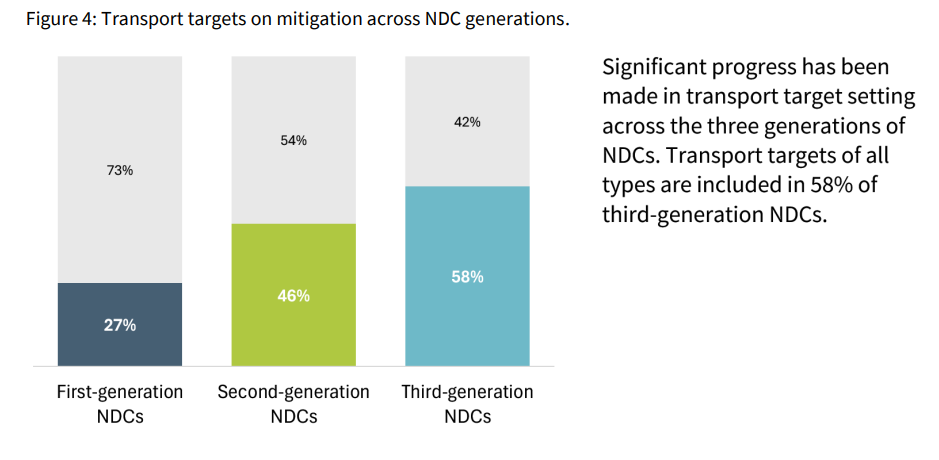
Adaptation tells a story of improvement while continuing to severely miss to satisfy needs. 16% of NDCs now set a transport adaptation and resilience target, up from 5% last time. The direction is right. The scale is the problem: even after that doubling, five out of six countries still set no adaptation target for the sector at all, at a point when the climate crisis has stopped being a forecast and become a condition their infrastructure already lives with. More plans are naming the risk. Very few are yet committed to managing it.
Targets to mitigate transport emissions rise on the same slow curve. 29% of NDCs, 32 plans, now carry an explicit target to cut transport emissions, up from 19% and 11% in the two generations before. The line climbs, generation on generation. But a target in fewer than a third of plans is still a gap.Most countries limit their ambition to transport action rather than guide themselves by a strong target. The progress is real. So is the distance left to cover.
Where governments hesitated far less was technology. 78% of NDCs, 86 of 110, include vehicle electrification actions, by far the most referenced measure in transport, and the NDC Transport Tracker logs 255 e-mobility actions, a quarter of everything captured. Countries heard the first Global Stocktake’s call to cut road transport emissions “on a range of pathways” (see the GSR4 chapter “National Transport Pathways to Reach Climate and Sustainability Goals“), and then interpreted mostly the electrification into it. The more visible, more industrially attractive lever got the attention. The harder ones, the measures that change how much and how we travel, are the subject of the next section, and of most of what these plans leave undone.
But still many shortcomings and blind spots
Here is where the arithmetic stops being flattering. Quantitative improvement is not the same as qualitative ambition, and the third generation of NDCs proves it. The level of detail, specificity and ambition of transport actions varies considerably from one plan to the next.
Adaptation shows the pattern most clearly. Transport adaptation in NDCs remains largely confined to infrastructure resilience, with a heavy emphasis on climate-proofing roads. Asphalt that survives a heatwave is a good thing. People not being able to move conveniently and safe is a bad thing. NDCs miss out on considering adapting transport operations to weather events, providing reliable alternatives and informing transport users in advance. Greater effort is needed on system-wide adaptation and on the institutional capacity to deliver it.
That matters because of what the science tells us. According to the Intergovernmental Panel on Climate Change, transport emissions must fall at least 59% by 2050 from modelled 2020 levels to hold warming within 1.5°C. The GSR4 chapter “10 Years After the Paris Agreement and the 2030 Agenda, on the Path to the UN Decade of Sustainable Transport” sets out the required trajectory. Mitigation action is heavily focused on ‘improve’ measures because of the concentration on zero-emission vehicles and e-mobility, 65% of all actions. “Shift” measures, which move people and goods onto lower-emission modes, account for 27%. “Avoid” measures, which reduce the need for motorised travel through urban planning and demand management, account for 8%. Worse, “Avoid” and “Shift” have both declined in share between the second and third generation of NDCs, while “Improve” has continued to climb. Countries ignored the “range of pathways” piece of the first Global Stocktake which covers “Avoid” and “Shift”.
Set the targets against that number, and they thin out further. At least six countries define their transport targets against a business-as-usual scenario, which in many cases implies continued growth in transport emissions, or growth merely slowed, rather than decarbonisation. Targets defined against a base year are the ones that bite, particularly for major emitters, and 9 countries have set them in a way that would deliver absolute reductions, only nine. And with the exception of the European Union, thanks to the Green Deal and the Fit-for-55 package, not one of the world’s major transport emitters has put a transport greenhouse gas emission reduction target in its plan. The sector’s ambition, measured where it counts, sits almost entirely outside the countries whose emissions decide the outcome.
Breaking it down to regional levels
Zoom in, and the global average disperses into six very different stories.
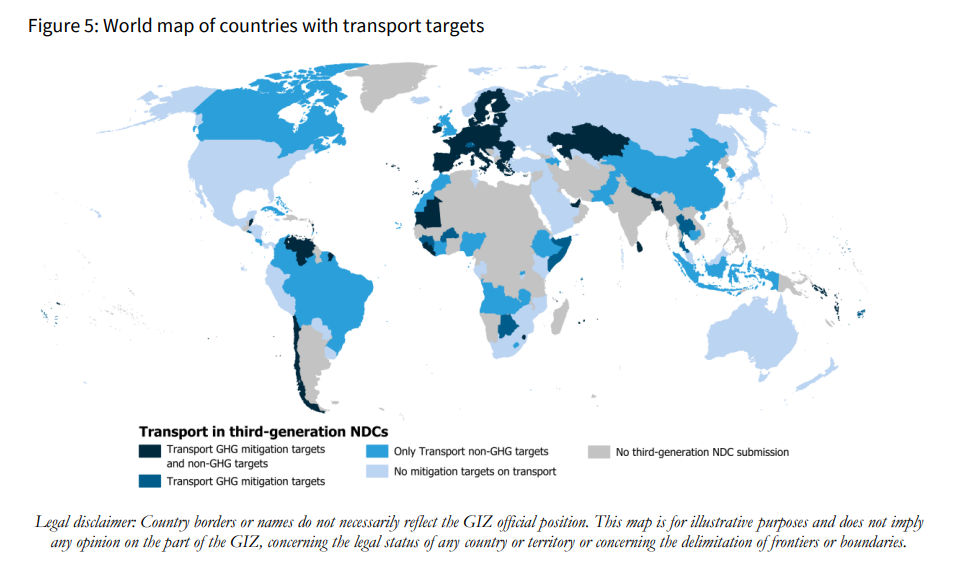
Africa contributes the least to global transport emissions and carries the strongest future ambition on resilience: more than half of every transport resilience target on the planet sits inside African NDCs. Asia records the largest number of transport mitigation actions of any region, and needs the strongest ambition of any region, because it is the largest source of transport greenhouse gas emissions due to rapid economic and population growth. Europe reaches near-universal coverage through the EU submission, and posts the highest share of demand-reducing actions anywhere. Latin America has featured modal shift actions into national climate policy at a scale no other region matches. North America (Canada and the United States), concentrates on modal shift and electrification, backed by economic instruments and public transport improvements. And Pacific states, whose exposure is existential to weather and climate crisis, including the sea-level rising threatening their own existence, are pledging decarbonised domestic shipping by mid-century.
The regions least responsible are writing the boldest plans. The regions that emit the most are writing the most cautious ones.
Next stop: Second Global Stocktake
Time is the constraint that none of this arithmetic escapes. Even if every commitment in every NDC were implemented in full and on schedule, the carbon budget for 1.5°C would be used up by 2032, according to the GSR4 Takeaways for Decision Makers.
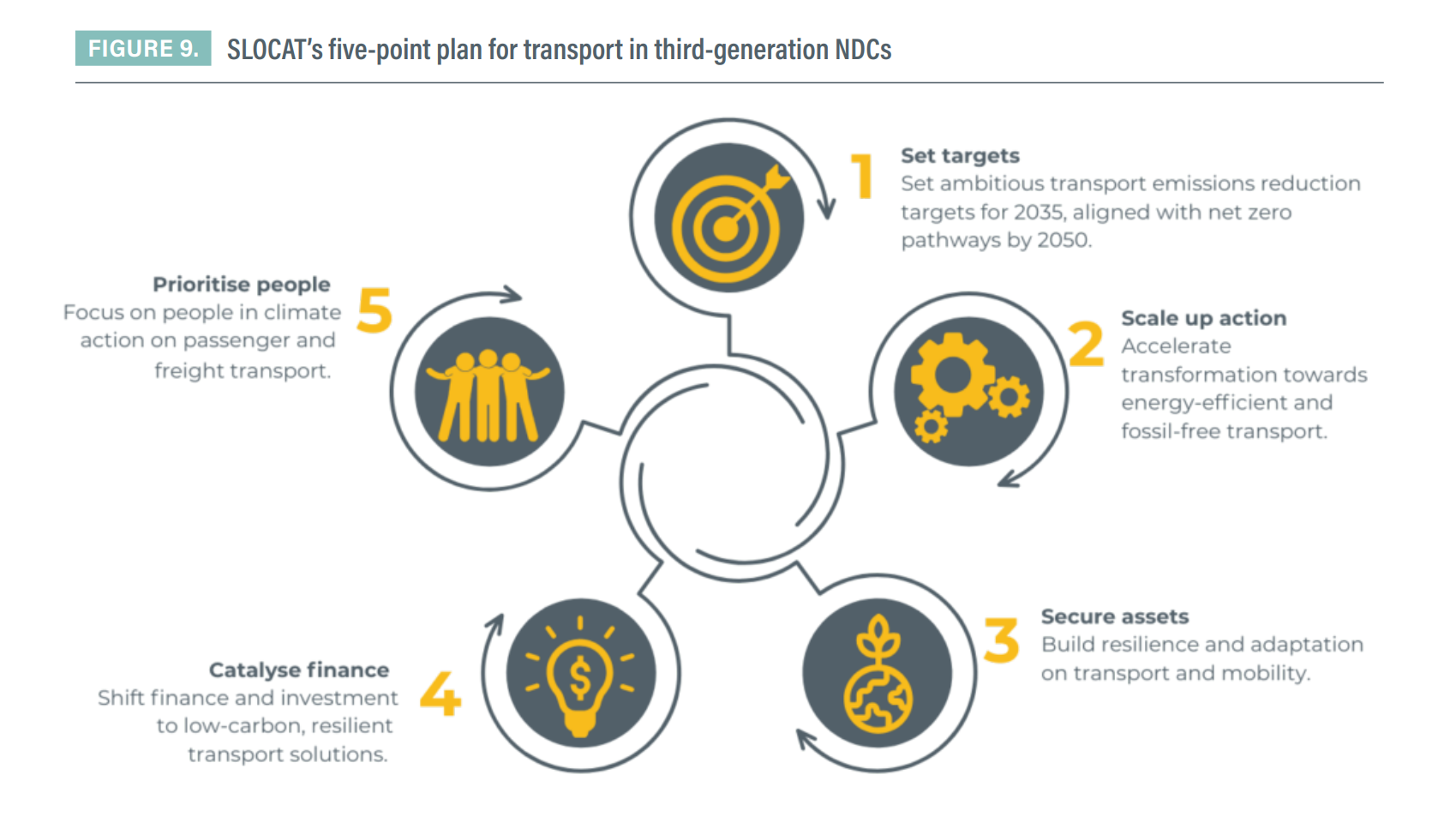
The next moment to take stock and raise ambition is the second Global Stocktake. It arrives with political momentum behind it and with the implementation plan of the UN Decade of Sustainable Transport (2026-2035) running alongside. SLOCAT launched in June the consultation phase of the Global Goal for Transport, whose purpose is to stitch a fragmented set of asks (across climate process, sustainable development process, UN Decade) into one coherent goal capable of raising both ambition and implementation in the next round of NDCs and beyond. Complementing this effort, SLOCAT is launching the Transport Stocktake to provide a clear assessment of progress and remaining gaps, helping to inform future national climate commitments and the second Global Stocktake.
Doubling the commitments was a first step that shows ambition. Transport has secured its place in national climate plans and struggles, so far, to translate the need into implementation at the pace and scale needed. More ambition, more regional discussion, more effort, and less time. The plans are written. The emissions are not falling, not yet.
All data drawn exclusively from the SLOCAT Transport, Climate and Sustainability Global Status Report, 4th edition (GSR4, 2025), the Regional NDC Dashboard by SLOCAT and the GIZ-SLOCAT NDC Transport Tracker.